Maximizing Flight Bookings with Optimizely Web Experimentation
- From Opinion to Revenue Discipline: The Case for Structured Experimentation
- What Alaska Airlines and Norwegian Air Proved With Data
- Why Experimentation Beats Redesign
- Where Revenue Disappears: Mapping Funnel Leakage Points
- The Leakage Points That Optimizely Tests Target First
- Search, Discovery, and Personalised Sorting
- Checkout Optimisation: Where the Biggest Gains Are Closest
- The 160% Conversion Lift: What It Took
- Urgency Mechanics: When They Work and When They Backfire
- Ancillary Revenue: The Experimentation-Driven Upsell
- Why Relevance Beats Volume in Ancillary Offers
- Mobile and Payment Friction: The Largest Untapped Channel
- Why Mobile Underperforms Despite Dominating Browse Behaviour
- Predictive Targeting: ML-Driven Personalisation at Scale
- How Machine Learning Identifies Hesitant High-Intent Users
- Experimentation as Infrastructure, Not a Project
- The Five Characteristics of Airlines That Win on Conversion
How Airlines Use Optimizely to Stop Losing 72% of Bookings
More than 72% of people who start booking a flight never finish — on mobile, it’s closer to 80%. This post breaks down exactly how airlines use Optimizely Web Experimentation to close that gap: from checkout field reduction (160% conversion lift) and predictive ML targeting to ancillary revenue experiments that generated 77–95% uplifts. Built for airline digital teams who want to turn their booking engine into a compounding revenue machine.
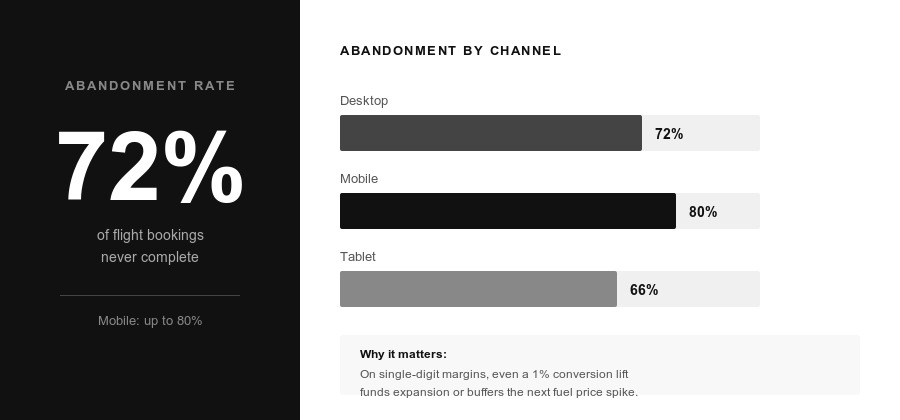
More than seven out of ten people who start booking a flight never finish. On mobile, that figure climbs closer to eight. For airlines operating on single-digit profit margins, those abandoned bookings represent real money walking away: revenue that funds route expansion, buffers against fuel price spikes, and determines whether direct booking can compete with OTA commission structures.
The airlines getting this right aren't redesigning on gut instinct. They're treating their booking flow as a testable system, using platforms like Optimizely Web Experimentation to validate changes against real user behaviour before rolling them out. Small adjustments, rigorously tested, compound into significant revenue gains.
From Opinion to Revenue Discipline: The Case for Structured Experimentation
What Alaska Airlines and Norwegian Air Proved With Data
Alaska Airlines has publicly attributed between $200 million and $300 million in annual incremental revenue to digital optimisation programmes that systematically test features before deployment. New ideas don't ship because someone senior likes them; they ship because data shows they work. This isn't marginal improvement. It is a different operating model.
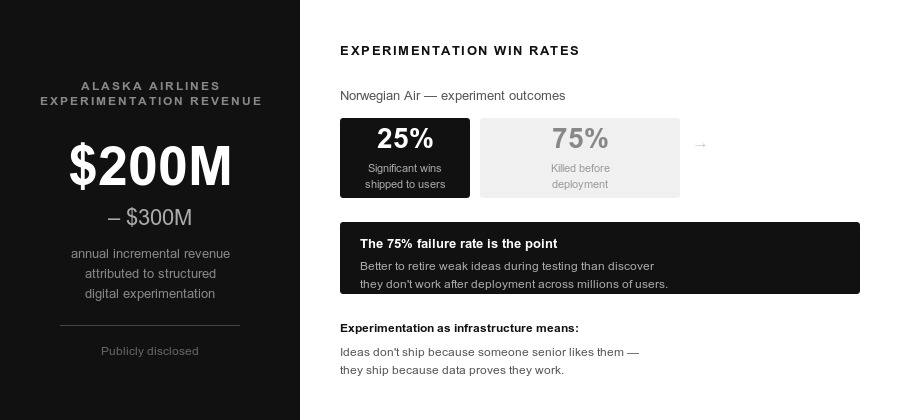
Left: Alaska Airlines publicly disclosed experimentation revenue. Right: Norwegian Air experiment win rates, with 75% of tests killed before deployment. Source: Public disclosures.
Norwegian Air shares that only 25–30% of their experiments generate statistically significant wins. The rest get killed. That failure rate isn't a problem; it's the point. Better to retire weak ideas during testing than discover they don't work after implementation across millions of customers.
Why Experimentation Beats Redesign
A full booking engine redesign takes 12–18 months, involves dozens of stakeholders, and bets the entire digital channel on a single untested hypothesis. Continuous experimentation runs dozens of hypotheses in parallel, with each test informing the next. The compounding effect over three years produces results that no single redesign project can match, and without the existential risk of a failed big-bang launch. For airlines already competing on booking engine performance, experimentation is the mechanism for turning speed improvements into measurable conversion gains.
Where Revenue Disappears: Mapping Funnel Leakage Points
The Leakage Points That Optimizely Tests Target First
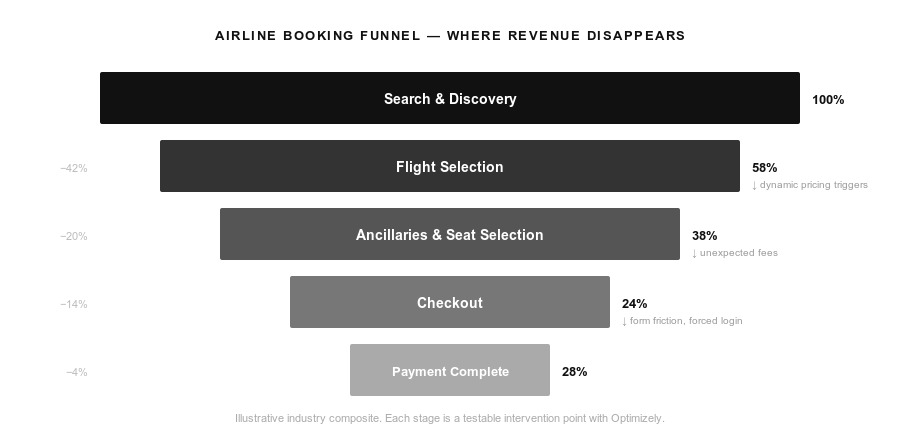
Airline booking funnel, illustrative industry composite. Each stage is a distinct testable intervention point. Source: Industry research composite.
Airline booking funnels leak at every stage. Dynamic pricing systems adjust fares using yield management algorithms, but sudden price jumps between fare classes trigger abandonment. A traveller sees one price, clicks to continue, encounters a higher fare; that sticker shock kills the booking before checkout friction compounds the problem further.
Unexpected fees appearing late in the process, excessive form fields, forced account creation, limited payment options, and mobile experiences designed for desktop each contribute to a cumulative abandonment rate that regularly exceeds 70%. When abandonment is that high, even small friction reductions at each stage have outsized impact on completed bookings.
Search, Discovery, and Personalised Sorting
Airlines test personalised result sorting based on user behaviour. Frequent travellers often prefer early departures, premium economy, and direct flights. Elevating those options first reduces cognitive load and shortens the path to selection. Interactive fare maps, which visually highlight lower fares across destinations, inspire bookings among flexible travellers that wouldn't happen with list views. The right presentation isn't universal. Optimizely determines what works for each specific customer segment.
Checkout Optimisation: Where the Biggest Gains Are Closest
The 160% Conversion Lift: What It Took
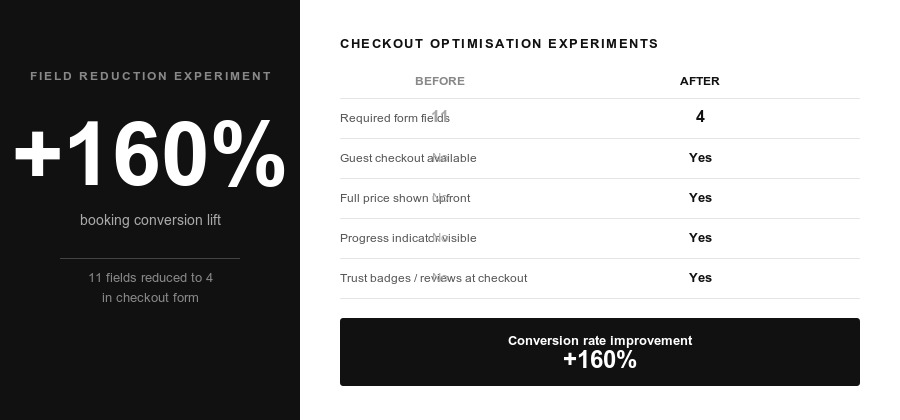
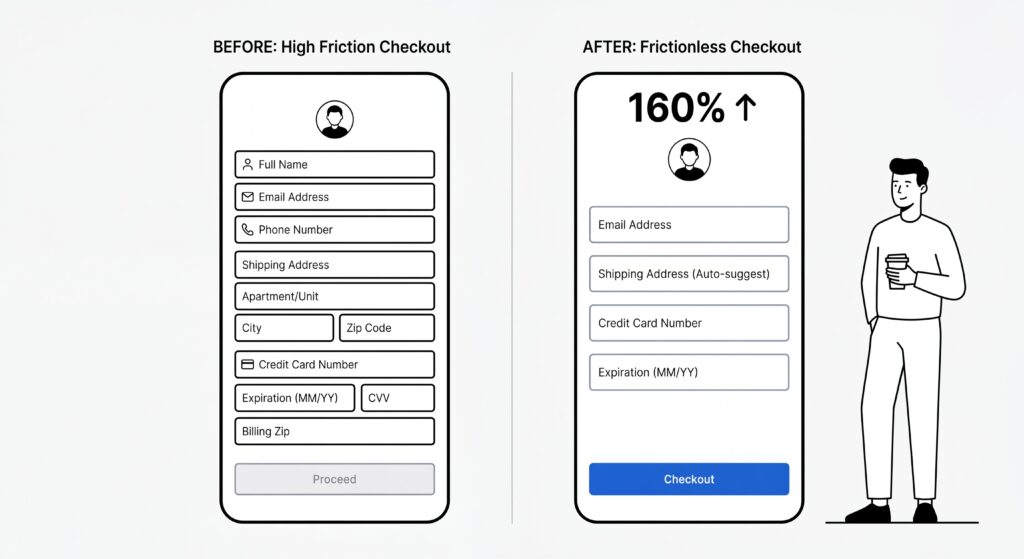
Documented experiment results: reducing required form fields from 11 to 4 increased booking conversion by 160%. Source: Published airline CRO case studies.
Documented experiments show reducing required booking fields from 11 to 4 increased conversion by 160%. Each additional field introduces friction, and friction compounds. Transparent pricing addresses another major trigger: displaying the full cost earlier in the journey reduces the surprise-driven exits that occur when fees appear at the final payment step.
Guest checkout preserves conversion; forcing account creation is a widely recognised barrier that experiments consistently flag as a significant abandonment driver. Progress indicators reduce perceived effort: visible progress bars increase completion rates because users are more likely to finish when they can see they are halfway through. Trust badges and verified testimonials at checkout drive double-digit booking improvements in travel commerce studies; urgency messaging works when it reflects actual inventory conditions.
Urgency Mechanics: When They Work and When They Backfire
Real-time booking indicators, such as "3 people booked this flight in the last hour", increase intent when authentic. Airlines operate under intense scrutiny on pricing transparency. When urgency messaging doesn't reflect actual inventory conditions, it does not just fail to convert; it actively damages trust and suppresses future bookings. Optimizely's value here is identifying, through test data, precisely which urgency formats work for your customer base and which erode confidence.
Ancillary Revenue: The Experimentation-Driven Upsell
Why Relevance Beats Volume in Ancillary Offers
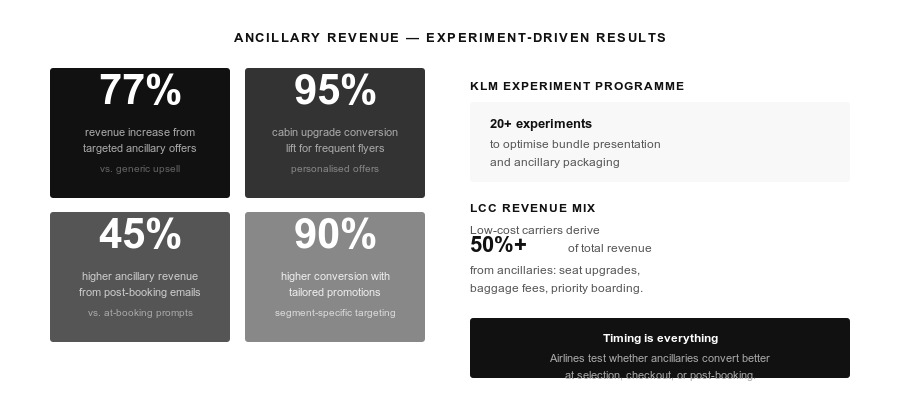
Ancillary revenue experiment data. KLM: 20+ bundle experiments. LCC sector: 50%+ revenue from ancillaries. Source: Industry research and public disclosures.
Low-cost carriers derive more than half their revenue from ancillaries: seat upgrades, baggage fees, priority boarding. KLM publicly shared running over 20 experiments to refine bundle presentation and ancillary packaging, improving both bundle uptake and overall booking performance. Industry research shows targeted ancillary offers generating up to 77% revenue increases, personalised cabin upgrades increasing conversion by 95% among frequent flyers, and post-booking emails producing 45% higher ancillary revenue than at-booking prompts.
These gains come from relevance, not blanket discounting. A business traveller cares about legroom and priority boarding. A family cares about baggage allowance. Timing matters too; airlines test whether ancillaries convert better during flight selection, checkout, or post-booking communication. The right Optimizely implementation partner can architect the experiment programme that identifies these patterns systematically across segments.
Mobile and Payment Friction: The Largest Untapped Channel
Why Mobile Underperforms Despite Dominating Browse Behaviour
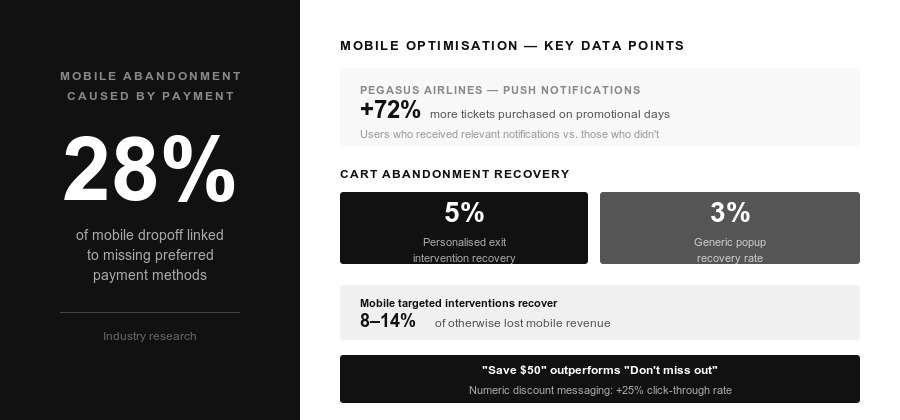
Mobile conversion gap: research shows 28% of mobile abandonment linked to missing preferred payment methods. Source: Industry research / Pegasus Airlines disclosure.
Mobile accounts for the majority of travel browsing but consistently underperforms desktop for booking completion. Research shows that the absence of preferred payment methods contributes to up to 28% of mobile abandonment. Integrating Apple Pay, Google Pay, and regional wallets reduces checkout steps from four to one, a dramatic friction reduction that experiments consistently validate as significant.
Push notification data from Pegasus Airlines shows users receiving notifications purchased 72% more tickets on promotional days compared to those who didn't. The key is relevance; messages about flash sales to people showing intent work. Generic blasts do not. Targeted exit interventions on mobile recover 8–14% of otherwise lost revenue; generic popups recover roughly 3%.
Predictive Targeting: ML-Driven Personalisation at Scale
How Machine Learning Identifies Hesitant High-Intent Users
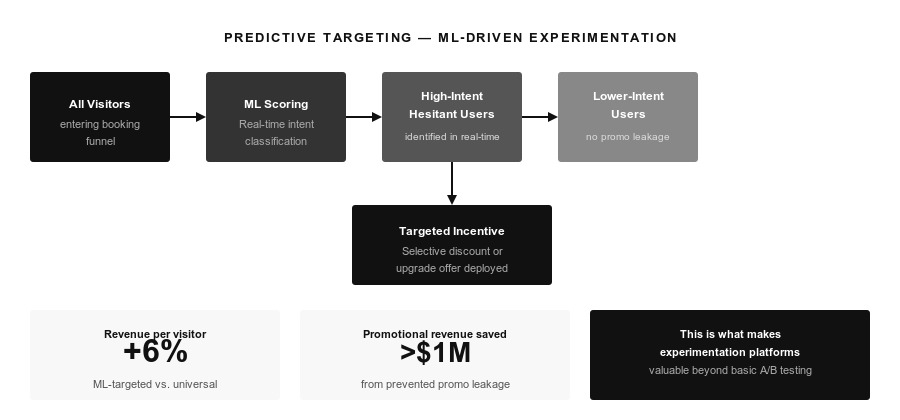
Predictive targeting model: ML scoring identifies high-intent hesitant users for selective incentive deployment, preventing promotional leakage to full-price buyers.
Machine learning identifies high-intent yet hesitant users in real time. Instead of universal discounts, which hand money to passengers who would have booked anyway, airlines deploy incentives selectively to the users most likely to abandon without a nudge. Case studies show this increasing revenue per visitor by up to 6% while preventing promotional leakage; certain implementations saved over $1 million that would have gone to customers booking at full price.
Numeric discount messaging outperforms emotional appeals by over 25% in click-through rate. "Save $50" works better than "Don't miss out." Some airlines offer temporary fare-hold options, allowing hesitant travellers to lock in fares briefly. When clearly disclosed, these reduce abandonment without the broad discounting that erodes yield. This is what makes experimentation platforms valuable beyond basic A/B testing; the intelligence layer that determines who gets which intervention.
Experimentation as Infrastructure, Not a Project
The Five Characteristics of Airlines That Win on Conversion
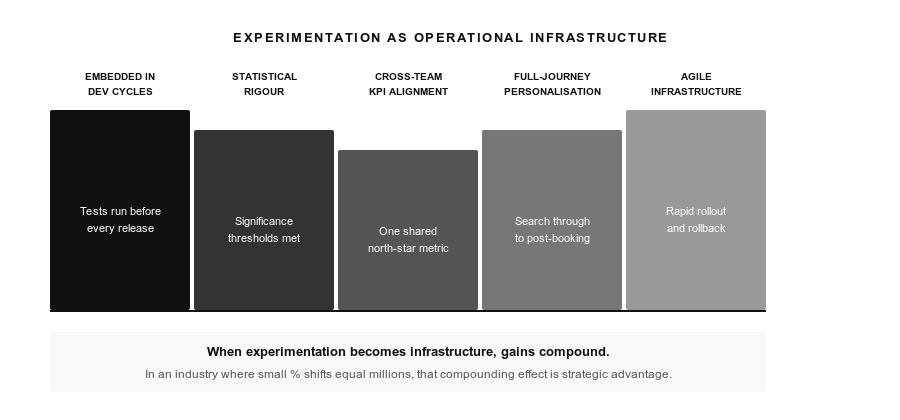
Five characteristics of airlines with sustained conversion gains through Optimizely-powered experimentation programmes.
Airlines seeing the strongest gains share five characteristics: experimentation embedded in every development cycle, statistical rigour in validating results, cross-team KPI alignment around a shared north-star metric, full-journey personalisation from search through post-booking, and agile infrastructure capable of rapid rollout and rollback.
Maximizing flight bookings isn't about one redesign or one clever tactic. It's about systematically reducing friction, increasing relevance, and capturing demand that would otherwise disappear into a competitor's booking flow. When experimentation becomes operational infrastructure rather than a project, conversion gains compound. In an industry where a single percentage point represents millions in revenue, that compounding effect is a structural competitive advantage.
The right implementation partner determines how quickly that infrastructure takes hold, and how reliably the statistical framework catches genuine winners versus noise. The platform's potential is realised only when the experimentation culture is embedded at every level of the product organisation.
Optimizely for Airlines — Platform Overview, Optimizely (2025) https://www.optimizely.com/airlines/ → How experimentation, personalization, and content management drive direct booking conversion
How Airlines Can Boost Direct Booking Conversions, Optimizely Blog (2025) https://www.optimizely.com/insights/blog/how-airlines-can-boost-direct-booking-conversions-and-advertisement-performance-with-optimizely/ → Personalised promotions, loyalty integration, and streamlined booking flows
7 Ways Optimizely Skyrockets Airline Digital Conversions, Optimizely Blog (2025) https://www.optimizely.com/insights/blog/taking-off-to-efficiency-7-ways-optimizely-skyrockets-airline-digital-conversions-and-cuts-operational-costs/ → Seven proven strategies including dynamic pricing display, A/B testing, and AI-powered recommendations
KLM Scales Its Test-and-Learn Culture with Optimizely — Case Study, Optimizely https://www.optimizely.com/insights/klm/ → KLM ran 20+ tests on a single booking flow, recovering and improving conversion rates
How VivaAerobus Uses AI to Experiment 3× Faster — DigginTravel (2025) https://diggintravel.com/airline-ab-testing/ → Airline-specific A/B testing methodology and velocity benchmarks
The Big Book of Experimentation — 45+ A/B Testing Case Studies, Optimizely https://www.optimizely.com/insights/ab-testing-case-studies/ → Cross-industry conversion uplift data from controlled experiments
Online Travel Market Size & Share Forecast 2026–2035, GM Insights https://www.gminsights.com/industry-analysis/online-travel-market → Mobile bookings exceeding 62% of all transactions; direct channel pressure from OTAs