Liferay DXP for Banking: Securing High-Volume Customer Portals
- <b><span dir="auto" style="vertical-align: inherit;"><span dir="auto" style="vertical-align: inherit;"><span dir="auto" style="vertical-align: inherit;"><span dir="auto" style="vertical-align: inherit;">Compliance as a Baseline, Not a Feature</span></span></span></span></b>
- <b><span dir="auto" style="vertical-align: inherit;"><span dir="auto" style="vertical-align: inherit;">Infrastructure: Scaling on Google Cloud Platform</span></span></b>
- <b><span dir="auto" style="vertical-align: inherit;"><span dir="auto" style="vertical-align: inherit;">Granular Access Control and Identity Management</span></span></b>
- <b><span dir="auto" style="vertical-align: inherit;"><span dir="auto" style="vertical-align: inherit;">Strategic Business Outcomes</span></span></b>
- <b><span dir="auto" style="vertical-align: inherit;"><span dir="auto" style="vertical-align: inherit;"><span dir="auto" style="vertical-align: inherit;"><span dir="auto" style="vertical-align: inherit;"><span dir="auto" style="vertical-align: inherit;"><span dir="auto" style="vertical-align: inherit;">Implementation Considerations</span></span></span></span></span></span></b>
- <span dir="auto" style="vertical-align: inherit;"><span dir="auto" style="vertical-align: inherit;"><b><span dir="auto" style="vertical-align: inherit;"><span dir="auto" style="vertical-align: inherit;"><span dir="auto" style="vertical-align: inherit;"><span dir="auto" style="vertical-align: inherit;">Performance and privacy are not a trade-off. Both have to be absolute.</span></span></span></span></b></span></span>
Liferay for Banking: Performance & Privacy
Discover how Liferay DXP helps financial institutions handle massive payday traffic spikes while maintaining strict, field-level data privacy and regulatory compliance.
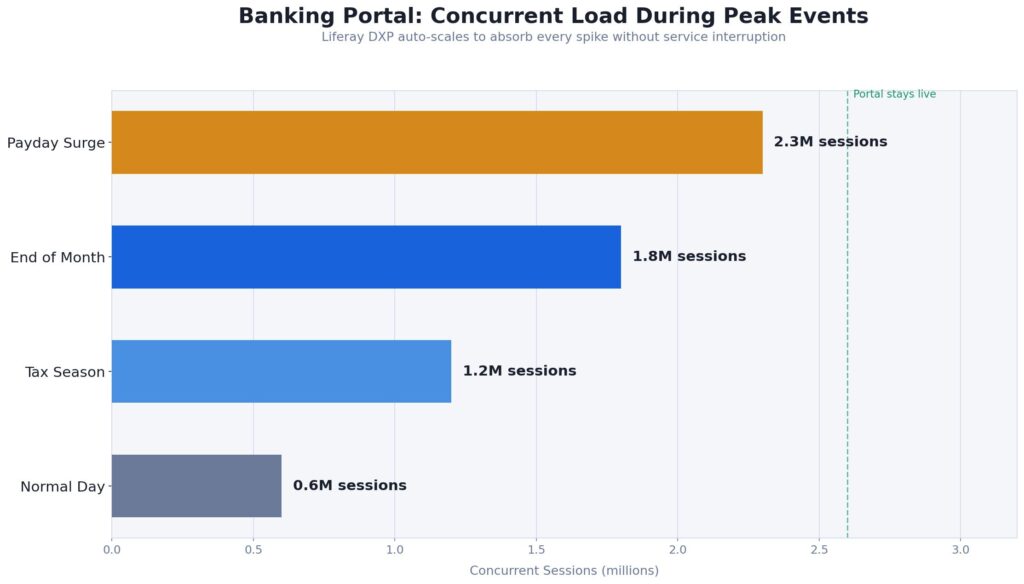
On payday, millions of customers hit the login button at the same moment. The bank's portal either holds or it doesn't.
For CIOs in financial services, that moment encapsulates the central challenge of modern digital banking: keeping the portal alive under massive concurrent load while ensuring that when one customer checks their balance, they cannot accidentally see another customer's loan agreement. Performance and privacy are not trade-offs. Both have to be absolute.
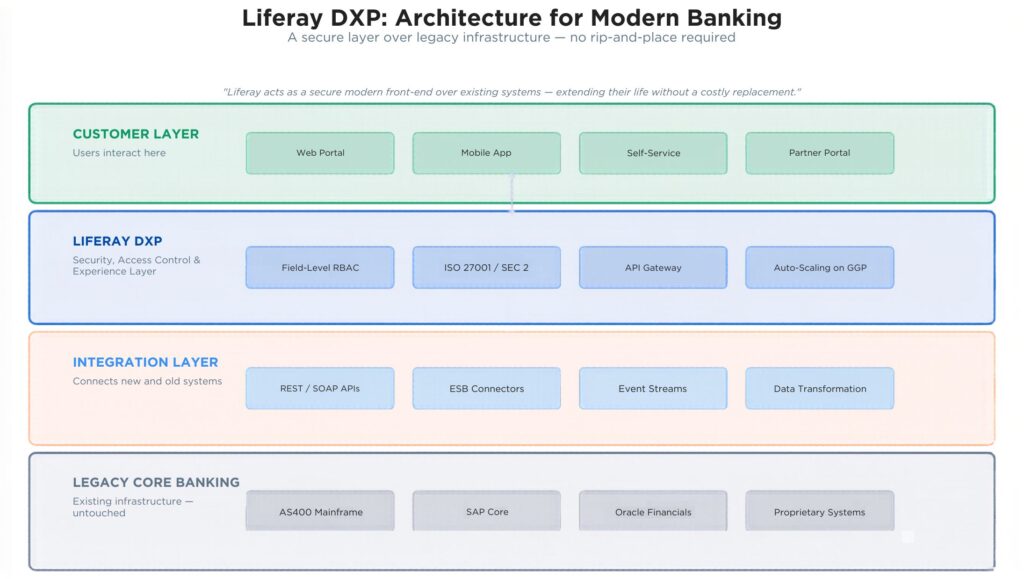
Liferay DXP addresses this through a layered architecture that pairs a compliance-ready cloud infrastructure with field-level access controls. This article breaks down how it works in practice and why more financial institutions are choosing it as the foundation for their customer portals.
Key Takeaways
- →GDPR breaches in financial services cost an average of $6 million per incident. Compliance infrastructure is the cheapest form of risk management available.
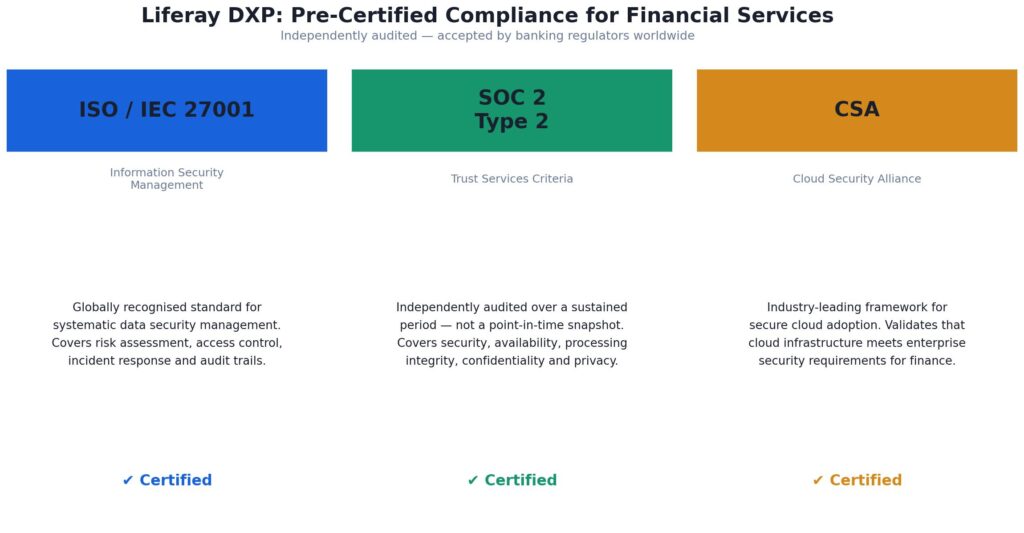
- →Liferay DXP ships pre-certified with ISO/IEC 27001, CSA, and SOC 2 Type 2, reducing internal compliance burden across procurement and audit cycles.
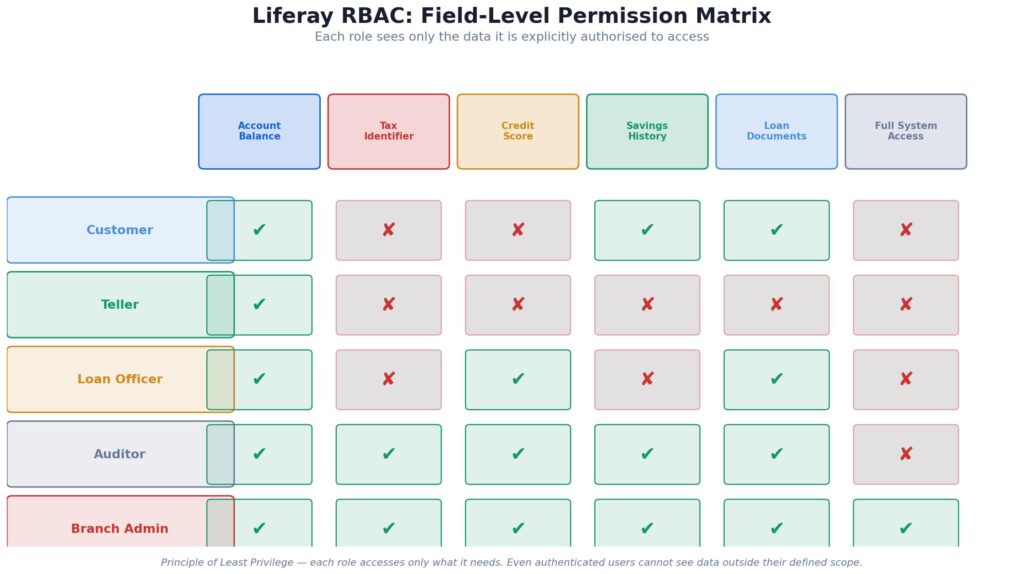
- →Field-level RBAC means a Teller sees account balances but not tax IDs. Data access is explicitly defined and independently auditable.
- →Correct configuration requires a verified Liferay specialist. A generic IT integrator produces generic results in a non-generic regulatory environment.
Compliance as a Baseline, Not a Feature
Regulatory adherence is not an optional add-on in banking. It is the starting condition. Under GDPR , a serious data breach can trigger fines of up to 4% of global annual turnover. IBM's 2024 Cost of a Data Breach Report consistently places financial services among the most expensive industries for breach remediation, with average costs exceeding $6 million per incident.
Liferay DXP ships with pre-certified compliance credentials, significantly reducing the internal compliance burden during procurement and audit cycles. The platform holds ISO/IEC 27001 certification, CSA validation, and SOC 2 Type 2 attestation, which are independently audited standards that banking regulators and enterprise procurement teams recognize.
Beyond certifications, the platform provides active defense mechanisms. Built-in protections address CSRF attacks, DDoS attempts, and injection vulnerabilities at the platform level. Banks receive proactive protection rather than a cycle of reactive patching after vulnerabilities are discovered.
"Compliance is not a project milestone. For a banking portal, it is the permanent operating condition. The question is whether the platform enforces it by architecture or by manual process."
Infrastructure: Scaling on Google Cloud Platform
Scalability in banking is not about raw throughput. It is about maintaining data integrity under massive concurrent load.
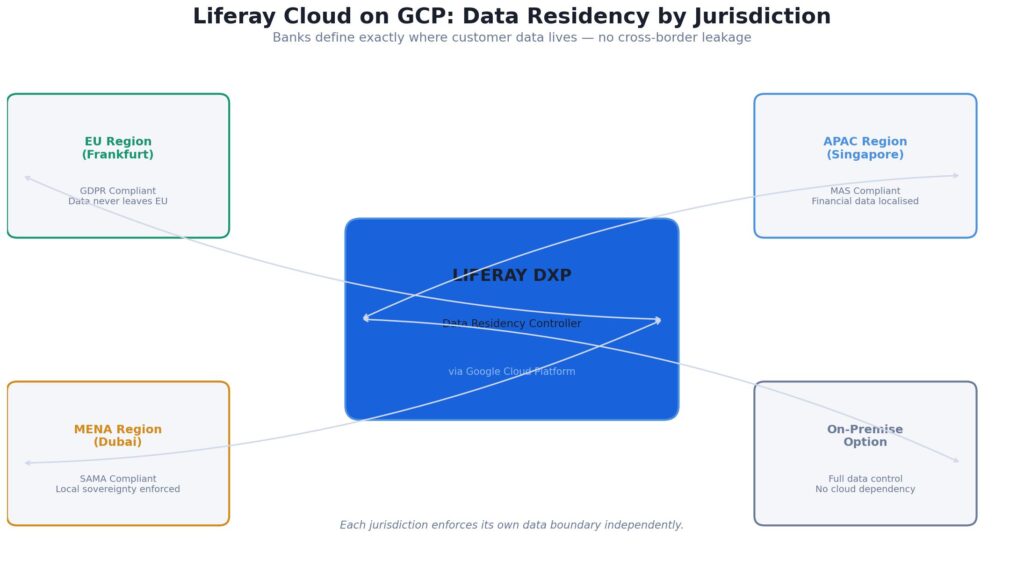
Liferay Cloud runs on Google Cloud Platform (GCP) , giving financial institutions precise control over data residency. Data sovereignty is a hard regulatory requirement for cross-border financial operations. A German bank cannot allow customer data to leave EU jurisdiction. A financial institution in Saudi Arabia faces its own localization mandates under SAMA regulations. Liferay Cloud's GCP infrastructure lets banks specify exact data residency locations and enforce that boundary without managing physical data centers in each country.
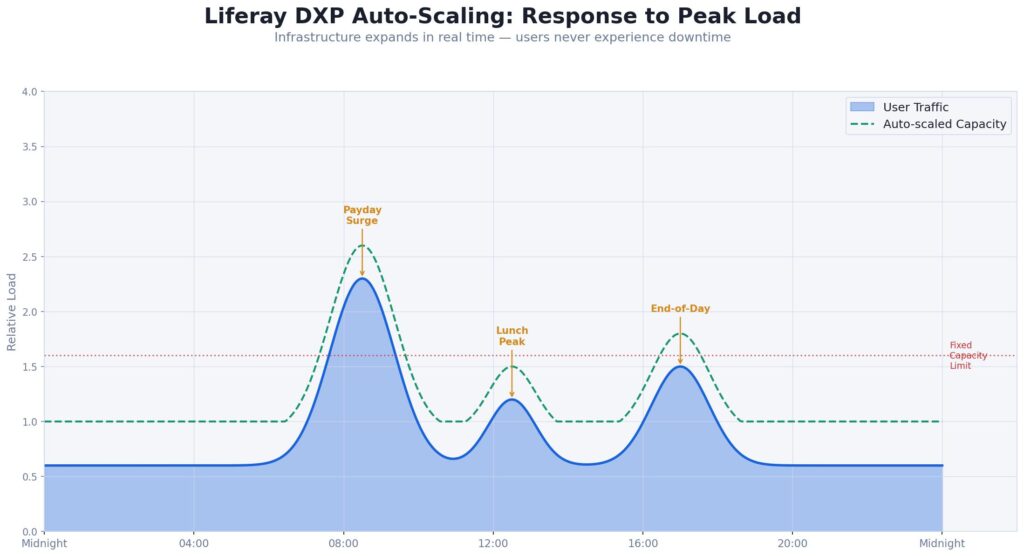
The architecture auto-scales during peak demand windows. End-of-month processing, payday surges, and tax-season spikes are handled without service interruption. The platform supports hybrid headless deployments alongside SaaS and on-premise options, which matters for institutions modernizing legacy core banking systems without a complete rip-and-replace.
Infrastructure
Granular Access Control and Identity Management
Logging in is the easy part. The harder problem is what each authenticated user is actually allowed to see.
Liferay implements a Role-Based Access Control (RBAC) system that restricts visibility at the data-field level, not just the page or section level. A Teller role can be configured to display a customer's account balance but not their tax identification number. A Loan Officer can access a credit score but not savings history. These permissions are explicitly defined and independently auditable, satisfying the principle of least privilege required by NIST's Cybersecurity Framework and ISO 27001.
This level of granularity matters for two reasons. First, it contains the blast radius of any internal breach: even a fully authenticated employee cannot access data outside their defined scope. Second, it simplifies regulatory audits: access logs show exactly who accessed what data, and when.
Field-Level
Strategic Business Outcomes
The operational case for this architecture extends well beyond regulatory compliance. Three business outcomes consistently emerge from financial institutions that deploy it correctly:
Customer trust as a competitive metric
When users encounter robust multi-factor authentication, consistent uptime, and visible security, the result is measurable long-term retention. PwC research consistently shows that digital experience quality is now among the top drivers of customer switching in retail banking.
Reducing technical debt
Legacy banking systems accumulate security patches over decades. Each custom patch is a liability that must be maintained, tested, and re-certified after every update cycle. Migrating to a certified, actively maintained platform eliminates the ongoing cost of custom security maintenance and substantially reduces audit preparation time.
Operational resilience during peak periods
For institutions where portal downtime translates directly into customer service calls and failed transactions, auto-scaling is a revenue protection mechanism. A portal that holds during end-of-month payroll processing is one fewer reasons for customers to reconsider who they bank with.
Implementation Considerations
Liferay DXP's capabilities are not automatic. Correct RBAC configuration at the field level requires a partner with genuine Liferay expertise, not a generalist IT delivery team. Data residency enforcement must be validated against the specific regulatory requirements of each jurisdiction the institution operates in. A generic approach produces a generic result.
Financial institutions evaluating the platform should insist on a security architecture review before implementation begins, and on a named partner with verifiable Liferay certifications. The platform provides the tools. The configuration determines whether they perform as intended under real-world load.
For banking teams evaluating enterprise portal platforms, Liferay DXP's combination of pre-certified compliance infrastructure , field-level access control, and flexible deployment options makes it one of the few platforms that genuinely addresses both the performance and the privacy requirements without treating them as trade-offs.
Performance and privacy are not a trade-off. Both have to be absolute.
The banking portal that holds on payday and ensures that when one customer checks their balance, they cannot see another's loan agreement is not a technical achievement. It is a business requirement that every implementation must deliver unconditionally.
Liferay DXP provides the certified infrastructure. The configuration (field-level RBAC, data residency enforcement, peak load architecture) is what a qualified implementation partner delivers. The gap between the two is where most banking portal failures occur.
Crafton specializes in Liferay portal implementations for financial services, combining certified platform expertise with a design-first approach to user experience. Start a conversation
[1] IBM Security — Cost of a Data Breach Report 2024 — https://www.ibm.com/reports/data-breach
[2] GDPR.eu — GDPR Fines and Penalties Explained — https://gdpr.eu/fines/
[3] ISO.org — ISO/IEC 27001 Information Security Management — https://www.iso.org/isoiec-27001-information-security.html
[4] NIST — Cybersecurity Framework — https://www.nist.gov/cyberframework
[5] NIST CSRC — Role-Based Access Control — https://csrc.nist.gov/projects/role-based-access-control
Google Cloud — Security and Compliance — https://cloud.google.com/why-google-cloud/security
PwC — Technology in Retail Banking — https://www.pwc.com/gx/en/financial-services/assets/pdf/technology-in-retail-banking.pdf
Cloud Security Alliance — About CSA — https://cloudsecurityalliance.org/
AICPA — SOC 2 Trust Services Criteria — https://www.aicpa-cima.com/topic/audit-assurance
SAMA — Saudi Central Bank Cybersecurity Framework — https://www.sama.gov.sa/en-US/RulesInstructions
European Banking Authority — ICT and Security Risk Management Guidelines — https://www.eba.europa.eu
Liferay — Security and Compliance — https://www.liferay.com/security
OWASP — Top 10 Web Application Security Risks — https://owasp.org/www-project-top-ten/
McKinsey — The value of digital transformation in banking — https://www.mckinsey.com/industries/financial-services
Gartner — Digital Experience Platforms — https://www.gartner.com/en/information-technology/insights/digital-experience-platforms
