Your Company Spent €500K on a CRM. 60% of the Team Is Still Using Spreadsheets.
Why Your CRM Has a 47% Adoption Rate
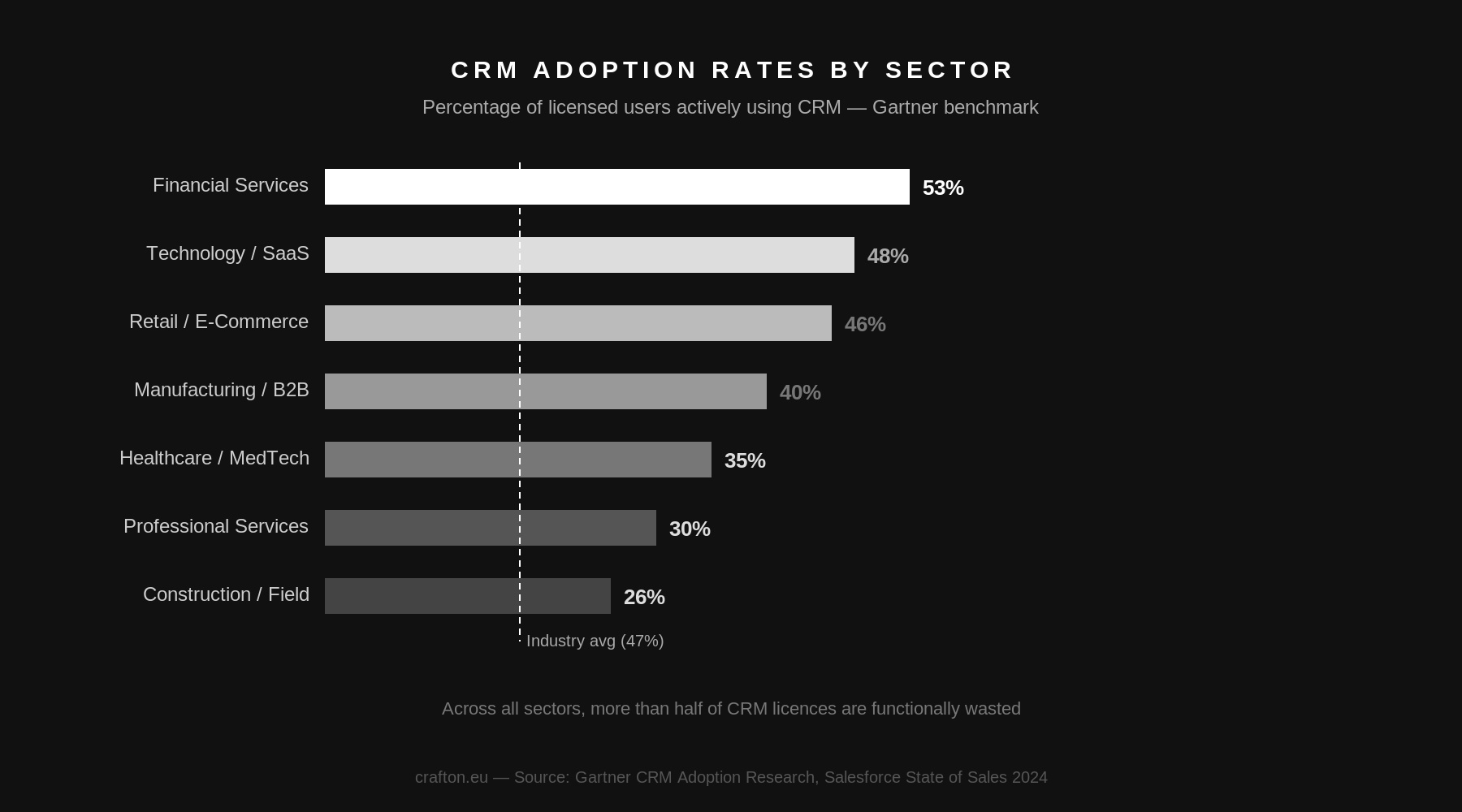
Gartner estimates average enterprise CRM adoption at 26–47%. Sales reps spend only 28% of their week selling. Both problems have the same root cause: interface design.
Your company spent six figures on a CRM. You had a 3-month implementation. You ran three training sessions. Six months later, your sales team is logging deals in a spreadsheet they share on Slack.
This is not a technology failure. It is not a change management failure either — or at least not only that. It is a UX failure. And it is happening at scale across the enterprise software market.
Salesforce's State of Sales research found that sales reps spend only 28% of their week actually selling. The rest goes to manual data entry, tool-switching, and system navigation. Gartner estimates CRM adoption rates average between 26% and 47% — meaning more than half of the people who are supposed to use the system actively avoid it.
The problem is not the feature set. Modern CRMs are extraordinarily capable. The problem is that they are built to satisfy procurement checklists and enterprise IT requirements — not the people who actually have to open them every morning.
Key Takeaways
→ CRM adoption rates average 26–47% in enterprise deployments. The majority of licensed users actively avoid the system.
→ Sales reps spend only 28% of their week selling — the rest goes to manual data entry and tool-switching driven by poor UX.
→ A CRM with 40% adoption on a €500K/year licence costs €300K in wasted seats — before accounting for the revenue lost from data not entered.
→ The top adoption killers — too many clicks, irrelevant fields, no mobile app, slow load — are all solvable UX problems, not feature gaps.
→ B2B SaaS companies with high DAU/MAU ratios command 2–3x higher NPS scores and significantly lower churn than those with low engagement.
47%
avg CRM adoption
in enterprise
28%
of week sales reps
spend actually selling
€300K
wasted on a €500K
licence at 40% adoption
Why Sales Reps Don't Use the CRM
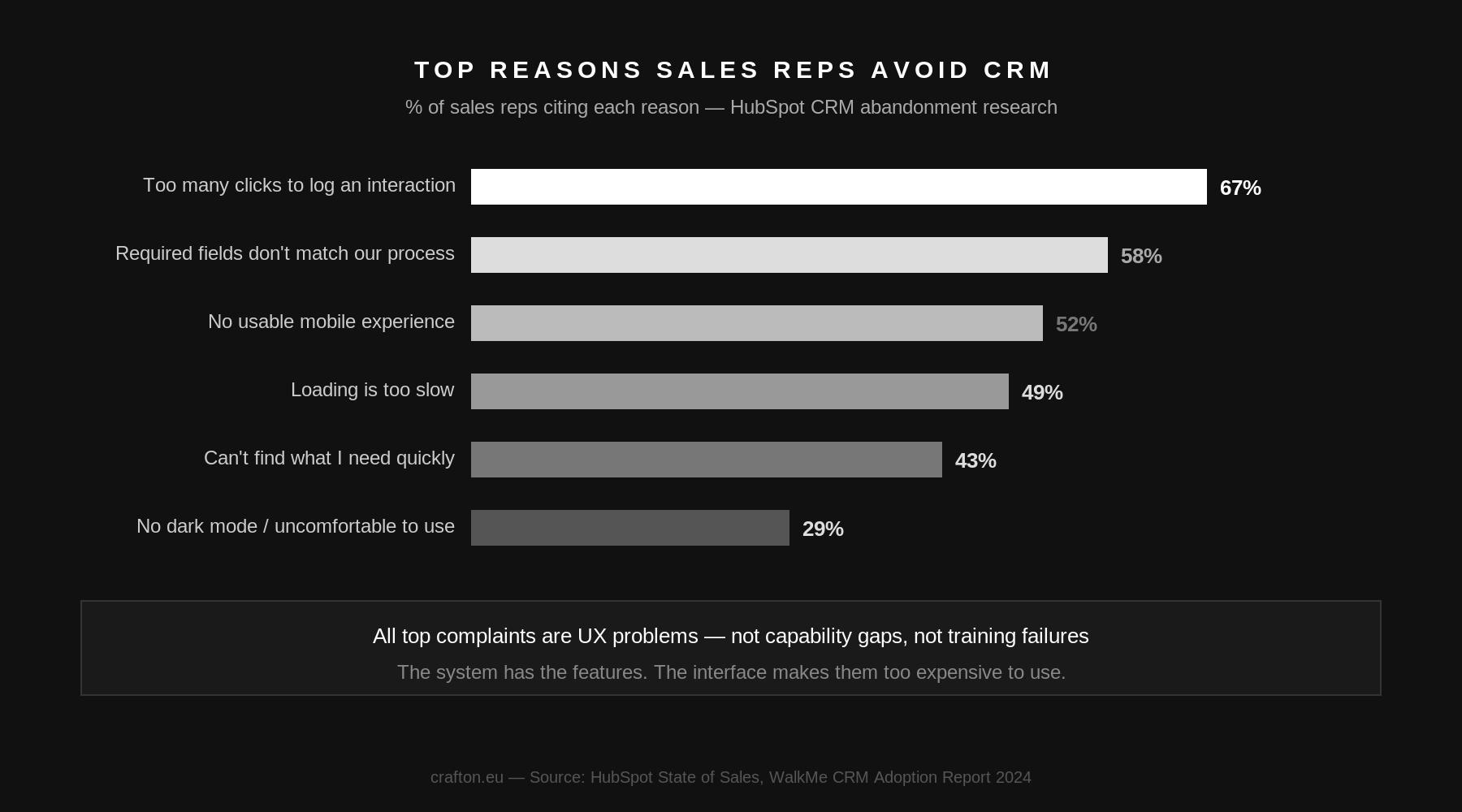
HubSpot's research on CRM abandonment found the following top reasons sales reps avoid their CRM:
— "Too many clicks to log a single interaction" (cited by 67%)
— "Required fields that don't match our sales process" (58%)
— "No good mobile experience — can't use it after a client call" (52%)
— "Loading is slow — I don't have time during a sales day" (49%)
Notice what is not on this list: "I don't understand how CRMs work," "I don't see the value," or "the data model is wrong." The top complaints are all interface complaints. They are about interaction cost — the number of actions required to complete a basic task.
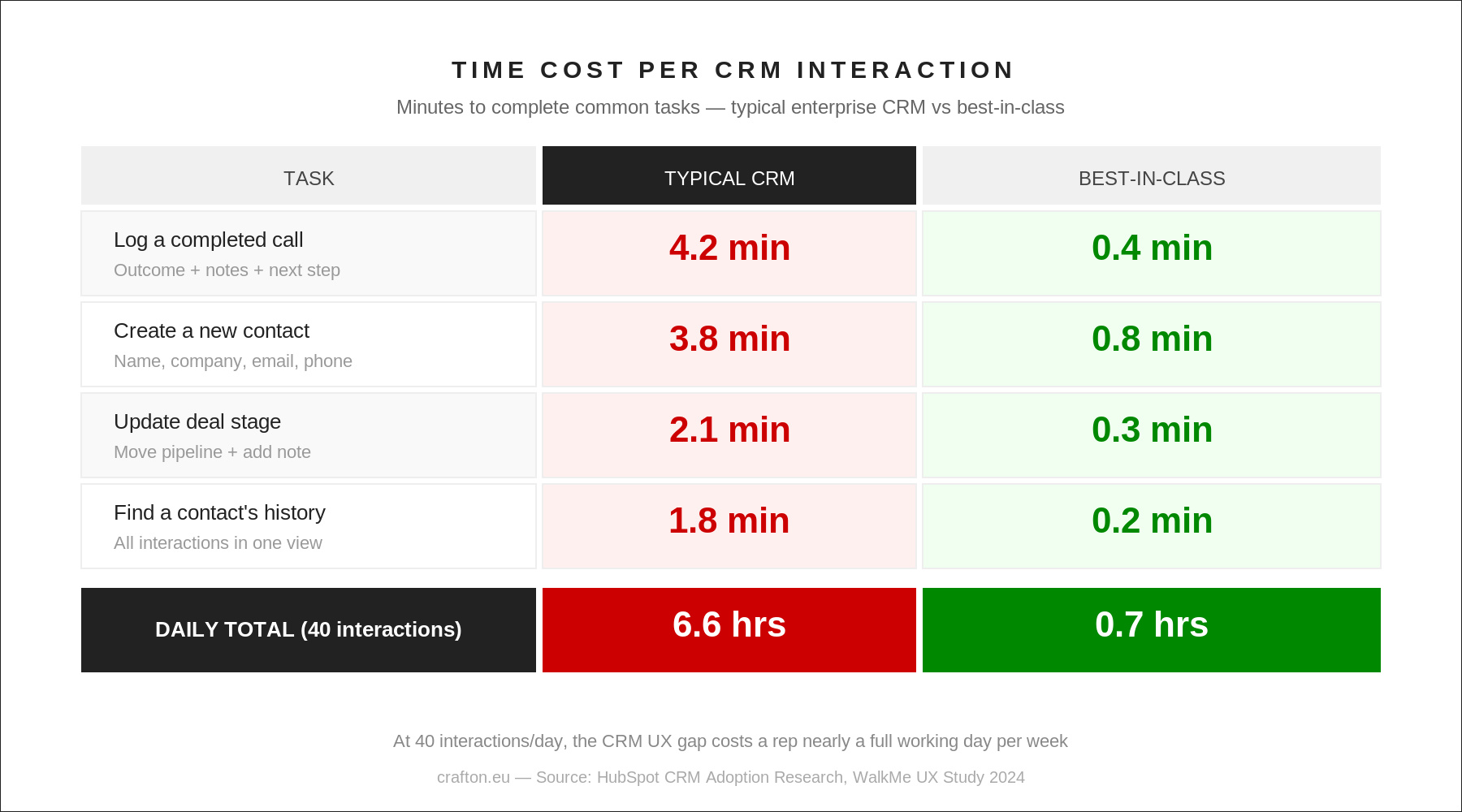
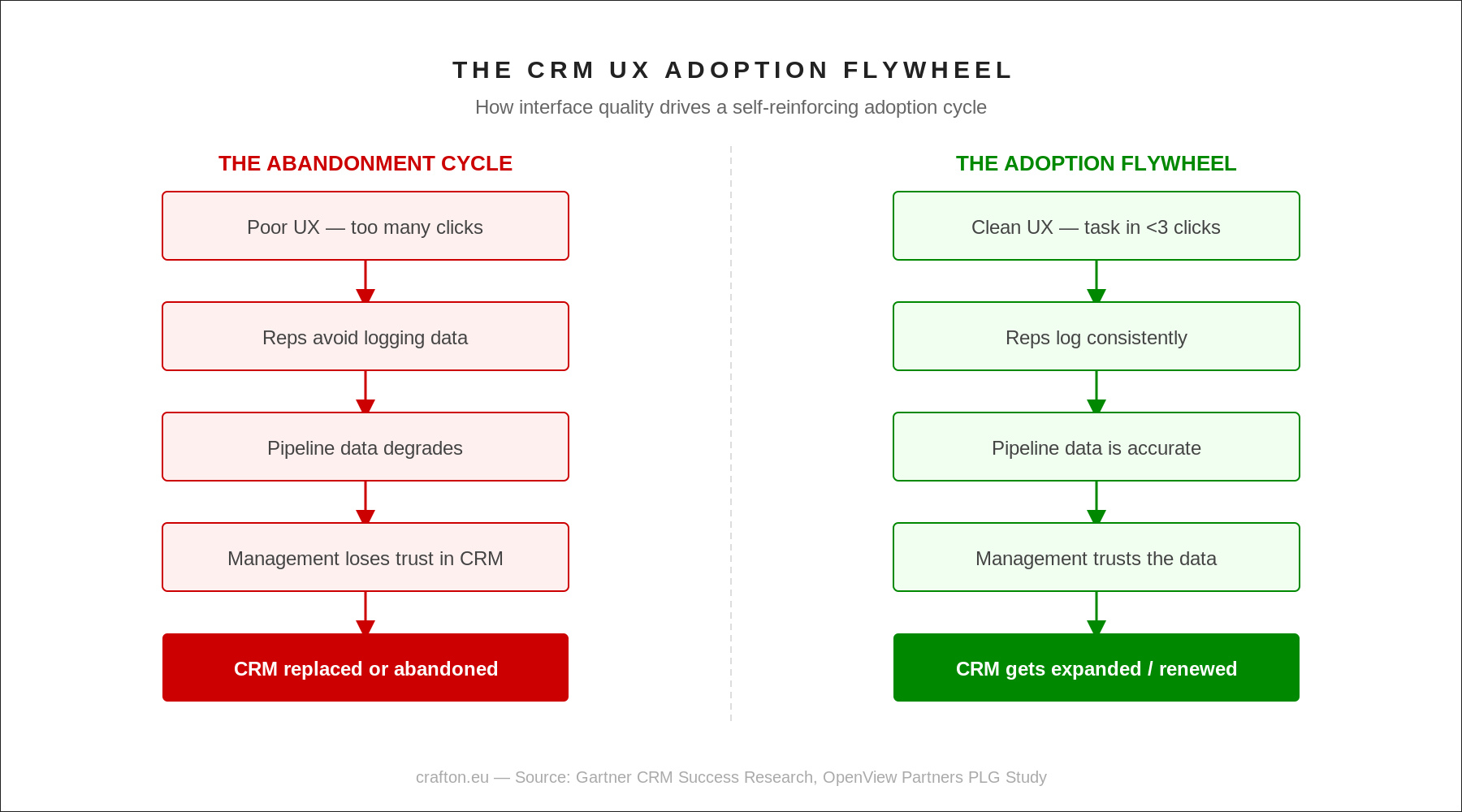
A sales rep making 40 calls a day should be able to log a call in under 30 seconds. If logging takes 4 minutes and 12 clicks — which is not unusual for enterprise CRM default configurations — the rep does mental maths and logs nothing. The pipeline data degrades. The forecasting breaks. The VP of Sales loses confidence in the system. The CRM becomes a report they fill in at the end of the quarter to keep management happy.
The Financial Cost of Low Adoption
Let us make the cost concrete. A company with 100 sales licences at €5,000 per seat per year is spending €500,000 annually on CRM licences. At 40% adoption — the Gartner average — 60 seats are either completely unused or used so rarely they contribute nothing. That is €300,000 in direct wasted spend.
But the direct licence waste is not the largest cost. The largest cost is data quality degradation. A CRM that is not used consistently does not have accurate pipeline data. Sales managers are making decisions — headcount, quota, forecasting — based on data entered inconsistently by 47% of the team. Gartner estimates that poor data quality costs organisations $12.9 million per year on average.
Then there is the opportunity cost. A sales rep spending 72% of their week on non-selling activities has a theoretical ceiling on revenue generation. If that rep could spend even 10 additional percentage points of their time on selling — a reasonable improvement through automation and UX simplification — the revenue impact at average quota attainment is significant.
"A CRM that sales reps avoid is not just a software problem. It is a revenue intelligence problem. You are flying blind."
Crafton — based on Gartner CRM adoption research
What High-Adoption B2B SaaS Looks Different
Notion, Linear, and Figma are products that teams adopt without being told to. They spread bottom-up because the people using them prefer them. They have high daily active user rates, low support ticket volumes, and strong word-of-mouth within organisations.
What makes them different from a typical enterprise CRM? The design principle is reversed. Traditional enterprise software is designed around data models and IT requirements — it captures everything a system administrator might ever need. Products like Linear are designed around the primary user's daily workflow — what does a developer need to do in the first 60 seconds of opening this tool?
The specifics that matter: keyboard shortcuts that actually work. Search that returns results before you finish typing. Default views that match the most common workflow. Mobile apps that are not a stripped-down afterthought. Inline editing without page reloads. Progressive disclosure — complexity available when needed, hidden when not.
These are not features. They are interaction patterns. They are the difference between a system people open because they have to and a system people open because it makes their day faster.
The Specific UX Changes That Lift CRM Adoption
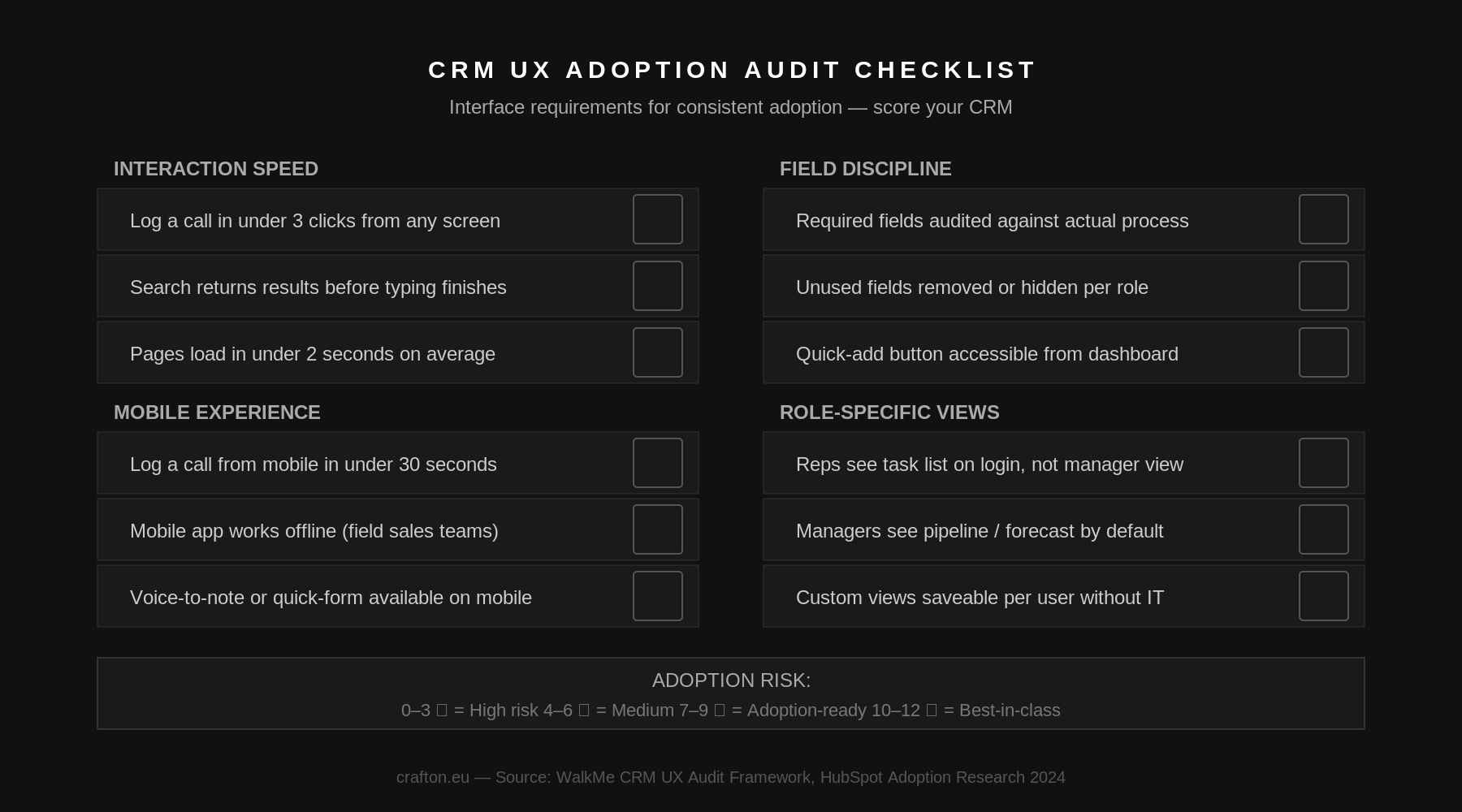
WalkMe's CRM adoption research identified the interface changes that have the highest correlation with adoption rate improvement. In order of impact:
Quick-add shortcuts. The ability to log a call, note, or contact in under 3 clicks from any screen. This single change in HubSpot's 2022 redesign was cited as the top reason for adoption improvement in their customer feedback.
Default field reduction. Removing required fields that do not match the actual sales process. Most CRM implementations start with the system's default field set and add more fields requested by managers. Nobody removes. The result is a data entry form that takes 4 minutes to complete. Auditing and removing unused required fields consistently drives adoption up.
Contextual views. Different roles see different defaults. A sales manager's home screen is a pipeline view. A rep's home screen is their task list. Showing the same default view to everyone is a common misconfiguration that makes the system feel irrelevant to most users.
Mobile-first logging. If the mobile app cannot log a call result in under 30 seconds in a parking lot after a client meeting, the log will not be created. The desktop data entry form does not help here. A native mobile voice-to-log or quick-form experience does.
For B2B SaaS Builders: Adoption Is Your Retention Strategy
If you are building a B2B SaaS product — not buying one — the CRM adoption crisis has a direct lesson for your roadmap. The products that survive in enterprise sales are not the ones with the most features. They are the ones that become habits.
OpenView Partners' product-led growth research shows that B2B products with DAU/MAU ratios above 40% — meaning users return daily within a monthly cohort — have substantially lower churn and higher expansion revenue than products with low daily engagement. The interface is the mechanism of habit formation.
The enterprise buyer evaluates your software. The end user decides whether your renewal happens. If the people using your product every day find it slow, confusing, or exhausting — the enterprise buyer who signed the contract will hear about it at renewal time. The CRM with 40% adoption gets replaced. The design team gets blamed last, after the sales team, after the implementation team. But the UX was the problem from day one.
The €500,000 licence that gets cancelled after 18 months was not a sales problem. It was a product design problem that closed at the right price and then made itself unwelcome.
Crafton is a B2B UX/UI design studio based in Poznań, Poland. We work with SaaS product teams on enterprise UX design that actually gets adopted. crafton.eu
Salesforce — State of Sales Report (28% selling time stat): https://www.salesforce.com/resources/research-reports/state-of-sales/
Gartner — CRM Adoption Rate Research (26–47% benchmark): https://www.gartner.com/en/sales/insights/crm-success
Gartner — Poor Data Quality Costs $12.9M/year: https://www.gartner.com/en/documents/3887767
HubSpot — CRM Abandonment and Adoption Research: https://www.hubspot.com/state-of-marketing
WalkMe — CRM Adoption Improvement Study: https://www.walkme.com/blog/crm-adoption/
OpenView Partners — Product-Led Growth and DAU/MAU Research: https://www.openviewpartners.com/blog/product-led-growth/
Notion — Product and Adoption Philosophy: https://www.notion.so
near — B2B SaaS UX Design Principles: https://linear.app
Figma — Enterprise Adoption and Bottom-Up Growth: https://www.figma.com
Amplitude — B2B SaaS Engagement Benchmarks 2024: https://amplitude.com/blog/saas-product-benchmarks
McKinsey — Digital Transformation and Enterprise Software ROI: https://www.mckinsey.com/capabilities/mckinsey-digital/our-insights/the-case-for-digital-reinvention
Forrester — Enterprise UX Investment and Adoption Correlation: https://www.forrester.com
Nielsen Norman Group — Enterprise UX and Productivity: https://www.nngroup.com/articles/enterprise-ux/
Statista — Global CRM Market Size and Adoption Trends 2024: https://www.statista.com/topics/1638/crm/
Harvard Business Review — Why CRM Implementations Fail: https://hbr.org/2018/07/why-crm-projects-fail-and-how-to-make-them-more-successful

Marketing, new business